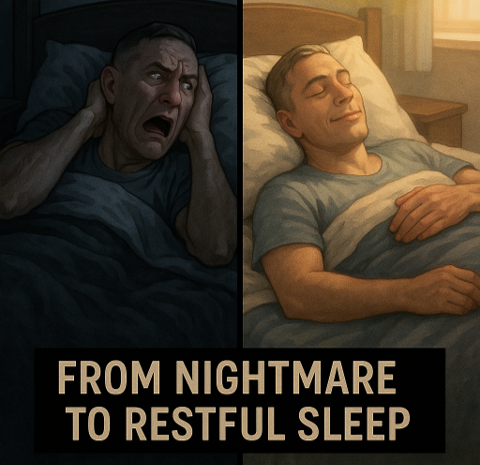
From Nightmare to Restful Sleep: Strengthening Nightmare Treatment with Multi-Sensory VR
Nightmares are one of the most common and disabling symptoms for deployed military personnel and veterans with post-traumatic stress disorder (PTSD). This Dutch Veterans Institute (NLVi) funded project develops and tests a new Multi-Sensory Virtual Reality Imagery Rehearsal Therapy (MVR-IRT) protocol to improve outcomes of nightmare treatment in this high-need group.
CORE IDEA
Standard Imagery Rehearsal Therapy (IRT) rewrites the ending of a recurring nightmare and rehearses the new script. MVR-IRT adds AI-generated, multi-sensory VR dream environments so that veterans can experience their new dream in a highly realistic, safe and controllable way. The goal: fewer awakenings in terror, better sleep, and more capacity to live with PTSD instead of being ruled by it.
Why Focus on Nightmares and Sleep in Veterans?
Sleep problems are a key driver in the development and maintenance of PTSD. In military contexts, chronic sleep deprivation, circadian disruption and extreme stress combine to create severe and persistent sleep disturbances — with nightmares at the center.
Nightmares in PTSD Veterans
- More than 30% of veterans report significant sleep problems after deployment.
- Nightmares occur in 50–70% of veterans with PTSD.
- Content often replays traumatic events with intense fear and loss of control.
- Nightmares frequently remain even after otherwise successful PTSD treatment.
Impact on Daily Life
- Fear of nightmares leads to delayed sleep onset and long waking periods at night.
- Chronic fatigue, impaired concentration and emotional instability.
- Intrusive daytime memories of nightmare content.
- Strain on relationships, work, and social functioning.
Limitations of Standard IRT
Imagery Rehearsal Therapy (IRT) is the first-line treatment for nightmares and shows medium to large effects in civilian samples. But among veterans with chronic PTSD:
- 50–80% of patients do not benefit sufficiently.
- Drop-out is high, especially when imagery feels abstract or “not believable”.
- Lack of vivid emotional activation and difficulty “switching” to the new script limit success.
Research Aims & Key Questions
The project aims to make nightmare treatment more effective, engaging and tailored to the lived experience of veterans by adding multi-sensory VR to an established protocol.
Primary Aims
- Develop a new MVR-IRT protocol that integrates multi-sensory VR into standard IRT.
- Test whether nightmare frequency and intensity decrease during and after MVR-IRT.
- Evaluate feasibility and tolerability of multi-sensory VR in veterans with PTSD-related nightmares.
Secondary Aims
- Assess changes in physiological nightmare markers (REM density, heart rate, HRV).
- Measure improvements in sleep quality and sleep efficiency.
- Evaluate changes in PTSD symptom severity (PCL-5) across treatment.
Key Hypotheses
- Nightmare frequency and intensity, measured via sleep diaries, will decrease with MVR-IRT.
- MVR-IRT will be rated as credible, acceptable and tolerable by veterans.
- During REM sleep, REM density and heart rate will decrease, while HRV will increase after treatment.
What Makes This Project New?
The proposal combines three innovative elements: upgrading an established nightmare protocol with multi-sensory VR, using AI-supported content generation, and adding objective physiological sleep measures.
Enhanced IRT, Not a New Therapy
Rather than replacing IRT, the project strengthens it by:
- Boosting emotional activation where imagination alone is too weak.
- Making the positive alternative ending feel real, not theoretical.
- Supporting mastery over the nightmare narrative – a key predictor of success.
Objective Sleep & Nightmare Markers
Beyond self-report, the study uses a lightweight EEG-headband (ZMax) to follow:
- REM density (lateral eye movements during REM sleep).
- Heart rate and heart rate variability.
- Sleep architecture and continuity in naturalistic settings.
Multi-Sensory, AI-Assisted VR
Using the Sensiks Sensory Reality Pod, the protocol adds:
- AI-generated visuals to approximate nightmare and alternative dream content.
- Coordinated sound, scent, temperature and airflow.
- Adaptive sensory intensity aligned with emotional state.
Design, Population & Measures
The study uses a rigorous multiple baseline single-case experimental design (SCED) with 12 veterans, allowing detailed tracking of individual change over time.
Design & Phases
- Work Package 1: Develop and refine the MVR-IRT protocol with expert and veteran input.
- Work Package 2: Test feasibility and preliminary effectiveness in a non-concurrent multiple baseline SCED.
- Baselines of 2, 3 or 4 weeks per participant with frequent repeated measures.
Study Population
- 12 active-duty military and/or veterans with PTSD and clinically significant nightmares.
- Recruited from ARQ Centrum’45 and MGGZ.
- Exclusions: acute psychiatric instability, active addiction, severe claustrophobia.
Key Measures
- Daily nightmare frequency and intensity (sleep diary).
- PTSD symptoms via PCL-5.
- Sleep parameters (sleep diary + EEG-headband).
- Feasibility: credibility/expectancy, cybersickness, satisfaction, adverse events.
How Sensiks and AI Strengthen the Therapy
Sensiks provides the multi-sensory hardware and software platform; AI tools support the creation of rich, personalized dream scenarios that can then be safely transformed.
Multi-Content Generation
Based on the first imagery session with the therapist, Sensiks helps translate nightmare and new dream scripts into immersive content:
- AI-generated scenes that closely approximate the veteran’s dream world.
- Custom soundscapes and recorded narratives of the new ending.
- Context-appropriate scents (e.g. forest, ocean, safe home).
Multi-Sensory Amplification
Inside the Sensory Reality Pod, these elements are combined into a coherent, controllable experience:
- Visual, auditory, olfactory and thermal cues presented in synchrony.
- Fine-grained control over intensity to avoid overload.
- Possibility to “dial up” positive sensory input at the new ending.
Encoding New Sensory Memories
The aim is not to erase the past, but to re-encode it:
- Veterans re-experience central elements of their nightmare in a new, safer storyline.
- The body learns a different sensory outcome at the emotional “hotspot”.
- Over time, the brain retrieves this updated version more often, reducing night-time shocks.
PLAIN LANGUAGE SUMMARY
In simple terms: AI helps build dream worlds that feel very close to what veterans actually experience at night. In the Sensiks cabin, they practice changing the ending while all their senses confirm, “You are safe now.” The goal is that, after enough repetitions, their sleeping brain follows this new script automatically — so they no longer wake up multiple times in panic.
Expected Impact for Veterans, Care and Research
The project is designed not only to test a new protocol, but also to lay the groundwork for broader implementation and larger randomized trials if results are promising.
For Veterans & Families
- Fewer and less intense nightmares.
- Better, more continuous sleep and daytime functioning.
- Less fear of going to bed; more sense of control.
- Reduced burden for partners and families.
For the Dutch Veteran Care Chain
- Evidence-based, tech-enhanced nightmare protocol for ARQ, MGGZ and LZV partners.
- Business case for limited number of Sensiks cabins serving multiple centers.
- Potential reduction in overall treatment time and costs per case.
For Science & Technology
- Model for combining SCED designs with digital therapeutics.
- Template for integrating AI-generated content into psychotherapy.
- Foundation for future RCTs comparing MVR-IRT with standard IRT.
NLVi Research Proposal: Full Dutch Application
The full Dutch-language research application, submitted to the Netherlands Veterans Institute, can be viewed directly below.
Development_new_protocol_for_the_treatment_of_nightmares_veterans_PTSD_Multi_Sensory_VR.pdf
Use the built-in controls to scroll and zoom, or open the document in a separate tab for detailed reading.
Turning Technology into Better Sleep for Those Who Served
By combining decades of clinical experience in nightmare treatment with cutting-edge multi-sensory VR and AI-generated dream content, this project aims to offer veterans more than symptom reduction: a renewed relationship with sleep, and a safer inner world at night.