Stress & relaxation • Multisensory ultra-reality

Quantifying the Relaxation Potential of Multisensory Nature Walk Experiences

Researchers at INRS-EMT and the Federal University of Health Sciences of Porto Alegre used the SENSIKS multisensory ultra-reality platform to compare a nature-walk-inspired session against traditional audio-visual virtual reality, combining subjective ratings with rich physiological measures of stress and relaxation.

16 participants • within-subject comparison IEEE MetroXRAINE 2022
16
Healthy adults in a within-subject design
50+
Physiological features extracted
2
Conditions: audio-visual VR vs. multisensory ultra-reality
Multisensory ultra-reality nature walk study using the SENSIKS booth
OVERVIEW

SENSIKS Validated as a Platform for Relaxation Research

The study “Nat(UR)e: Quantifying the Relaxation Potential of Ultra-Reality Multisensory Nature Walk Experiences” evaluated whether a digitally delivered, forest-bathing-inspired session in the SENSIKS booth could promote deeper relaxation than standard audio-visual VR. Findings support the use of multisensory technology as a robust research platform for stress reduction interventions.fileciteturn2file0

Academic Collaboration

The project involved an international research team, including:

  • INRS-EMT (Institut national de la recherche scientifique – Centre Énergie Matériaux Télécommunications), Montreal, Canada
  • MuSAE Laboratory, led by Prof. Tiago H. Falk
  • Federal University of Health Sciences of Porto Alegre (UFCSPA), Brazil
  • Researchers: Marilia K. S. Lopes, Belmir J. de Jesus Jr., Marc-Antoine Moinnereau, Reza A. Gougeh, Olivier M. Rosanne, Walter Schubert, Prof. Alcyr A. de Oliveira Jr., Prof. Tiago H. Falk

Study Aim

The central question was whether adding realistic sensory cues—such as wind, temperature changes, scents and vibroacoustic feedback—to a virtual nature walk would produce:

  • Higher self-reported relaxation compared to audio-visual VR alone
  • Objective physiological signatures of reduced stress and increased parasympathetic activity
  • Meaningful correlations between how relaxed people felt and how their bodies responded
TECHNOLOGY

The SENSIKS Multisensory Ultra-Reality Platform

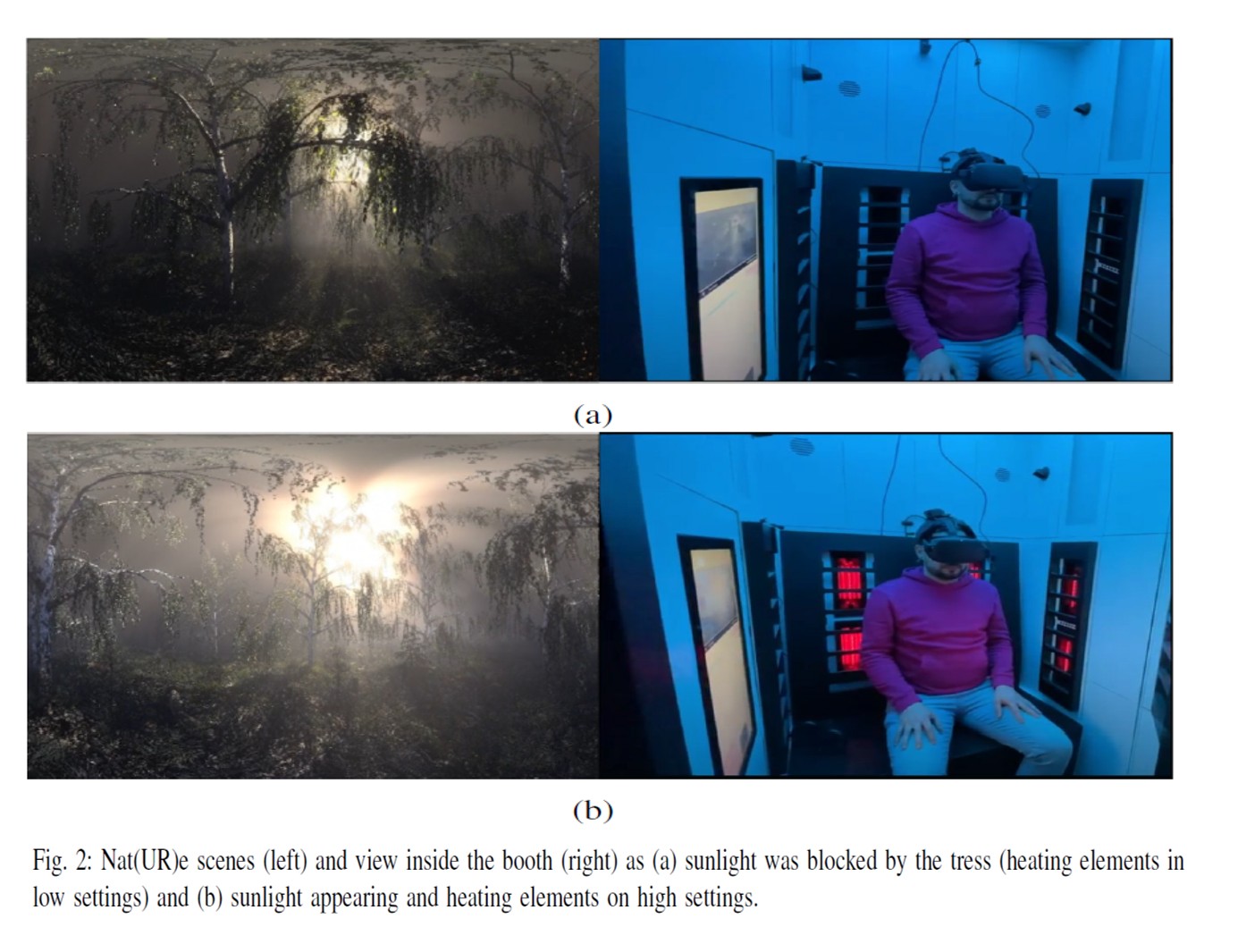
The SENSIKS booth is designed to recreate nature-like environments by synchronising multiple sensory channels, translating the principles of forest bathing (shinrin-yoku) into a controlled digital setting.fileciteturn2file0

Multisensory Features

  • 360° immersive video displayed through a VR headset
  • Spatial surround sound audio for environmental realism
  • Olfactory stimulation with scents such as forest, earth, grass and ocean breeze
  • Somatosensory feedback using fan systems for wind simulation
  • Dynamic temperature modulation via integrated heating elements
  • Vibroacoustic feedback using subwoofers beneath the seat

Why Multiple Senses?

The study builds on evidence that nature exposure works best when multiple senses are engaged:

  • Scents and natural sounds can tap into limbic system circuits linked to calm and safety.
  • Wind and temperature changes increase the sense of “being there” in the environment.
  • Vibroacoustic cues add a subtle bodily component that supports embodied relaxation.

The SENSIKS booth makes it possible to standardise and repeat such experiences in laboratory and clinical settings.

METHODS

Study Design and Physiological Monitoring

A within-subject design allowed each participant to serve as their own control, experiencing both a conventional audio-visual VR condition and the multisensory ultra-reality condition.fileciteturn2file0

Participants and Conditions

  • 16 healthy adults (mean age around 27 years)
  • Two experimental conditions:
    • Audio-visual virtual nature walk (standard VR)
    • Ultra-reality multisensory nature walk in the SENSIKS booth
  • Counterbalanced order to control for sequence effects
  • Short, structured exposures to minimise fatigue

After each condition, participants rated their level of relaxation using a standardised Relaxation Rating Scale.

Physiological Signals and Features

Participants wore two medical-grade devices throughout the sessions:

  • BioHarness3 chest strap: electrocardiogram (ECG) and breathing rate/pattern
  • Empatica E4 wristband: electrodermal activity (EDA), skin temperature and blood volume pulse (BVP)

The research team extracted more than 50 features across these signals, including heart rate variability components, EDA indices, respiratory metrics and temperature dynamics.

RESULTS

Evidence of Enhanced Relaxation in the Multisensory Condition

Subjective and objective data converged to show that the SENSIKS ultra-reality condition supported deeper relaxation than audio-visual VR alone.fileciteturn2file0

Subjective Relaxation

  • Participants rated the multisensory condition as significantly more relaxing than the audio-visual condition.
  • Relaxation Rating Scale scores were higher with p < 0.01.
  • Qualitative feedback indicated that the combination of sights, sounds, smells and physical sensations felt closer to a real nature walk.

Physiological Markers of Relaxation

  • Heart rate variability (HRV): increased high-frequency HRV, associated with parasympathetic activation and calm states.
  • Electrodermal activity (EDA): reductions in low-frequency EDA components and lower variability, consistent with reduced sympathetic arousal.
  • Blood volume pulse (BVP): changes compatible with cardiovascular relaxation.
  • Several indices reached statistical significance (e.g., EDA standard deviation with p < 0.05).
INTERPRETATION

Linking Perception and Biology: Correlation Analyses

An important contribution of the study is the demonstration that subjective reports of relaxation line up with objective biological signals.fileciteturn2file0

Correlations Between Feelings and Physiology

  • Heart rate variability features correlated with relaxation scores (e.g., r ≈ -0.41 for selected ECG-derived metrics).
  • Breathing pattern characteristics (e.g., respiratory rate and variability) showed correlations in the range r ≈ -0.46 to -0.50.
  • Electrodermal features yielded correlations around r ≈ 0.42 to -0.43, depending on the specific index.

These associations suggest that when people report feeling more relaxed in the SENSIKS booth, their nervous system activity reflects that state.

Implications for Mental Health Interventions

The convergence of subjective and physiological data indicates that multisensory VR can be used not only as an engaging experience, but also as a measurable intervention platform for:

  • Stress and anxiety reduction programmes
  • Complementary support in PTSD and trauma-related disorders
  • Workplace or occupational health stress management
  • Preventive mental health and relaxation training

The study does not replace established therapies, but it provides a research foundation for future clinical applications.

FULL STUDY

Read the IEEE Conference Paper

For detailed methods, statistical analyses and full physiological feature descriptions, consult the original IEEE MetroXRAINE 2022 publication.

If the PDF does not load, you can open the full Nat(UR)e study PDF in a new tab .

FAQ

Frequently Asked Questions

These short answers summarise key elements of the study. They do not constitute clinical guidelines or treatment recommendations.fileciteturn2file0

What is the main contribution of this study?

The study shows that a carefully designed multisensory nature walk, delivered via the SENSIKS booth, can produce higher self-reported relaxation and measurable physiological signatures of stress reduction compared to standard audio-visual VR. It also demonstrates that the platform is suitable for rigorous scientific evaluation.

Does this mean multisensory VR can replace traditional therapies?

No. The study focuses on short-term relaxation in healthy participants. While the findings are promising for stress management and future clinical work, they are not a substitute for established treatments for anxiety, depression or PTSD. Clinical implementation requires additional research in patient populations.

How could this technology be used in everyday settings?

Potential applications include relaxation rooms in healthcare facilities, workplace recovery spaces, support for people with limited access to nature and adjunct tools in mental health services. Any therapeutic use should be supervised and grounded in evidence-based practice.

Interested in Multisensory Relaxation Research with SENSIKS?

This page is an educational overview of an independent relaxation study using the SENSIKS multisensory platform. For collaboration, implementation or further information about using ultra-reality nature walks in stress and mental health research, please get in touch.

Contact SENSIKS