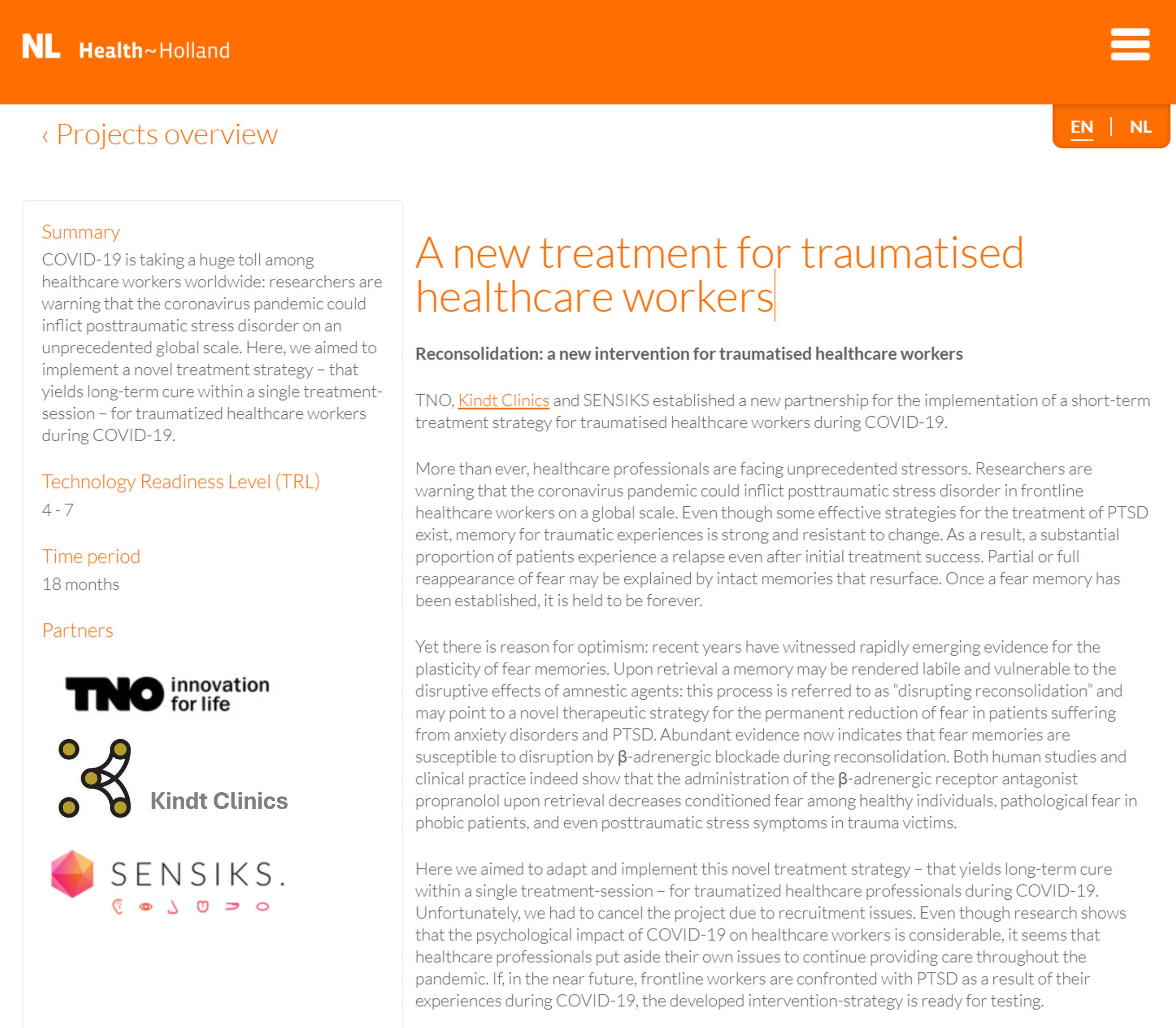
Rapid-Response Treatment Design for Traumatized Healthcare Workers
SENSIKS joined forces with TNO (Netherlands Organisation for Applied Scientific Research) and Kindt Clinics to design a short-term reconsolidation-based treatment for healthcare workers who developed trauma during the COVID‑19 pandemic. The collaboration united applied research, clinical innovation, and sensory environment engineering to address an emerging occupational PTSD crisis.
MISSION
Develop a single‑session PTSD intervention based on memory reconsolidation, using propranolol and controlled Sensory Reality™ environments, specifically tailored to the time‑constrained reality of frontline healthcare professionals.
PTSD & Moral Injury in Healthcare Workers
COVID‑19 exposed healthcare workers to unprecedented levels of stress, moral injury and repeated trauma, while at the same time limiting their capacity to seek help.
Unprecedented Stressors
- Multiple patient deaths in compressed timeframes.
- Resource scarcity and triage decisions leading to moral injury.
- Constant infection risk for self and family.
- Months of continuous overload with little recovery time.
Limits of Existing Treatments
Conventional trauma‑focused therapy often requires 12–20 weekly sessions. Even when effective, the underlying fear memory remains intact, which can lead to partial or full relapse under stress.
For healthcare workers in crisis, such long treatment programs were simply not feasible during the pandemic's acute phases.
The Time Constraint
Healthcare workers continued to prioritize patients over their own mental health, making recruitment into multi‑session trials extremely difficult. A rapid, one‑session approach was uniquely suited to this population.
From "Fear Is Forever" to Memory Reconsolidation
The partnership translated contemporary neuroscience on memory reconsolidation into a practical, clinic-ready protocol for occupational trauma in healthcare.
Paradigm Shift
Traditional thinking treated fear memories as permanent once formed. Emerging evidence shows that when a memory is reactivated, it briefly enters a labile state during which it can be modified before being stored again.
β‑Adrenergic Blockade
Research has demonstrated that administering propranolol (a β‑adrenergic blocker) during the reconsolidation window can weaken the emotional charge of fear memories:
- Lab studies: reduced conditioned fear in healthy volunteers.
- Clinical work: reduced pathological fear in phobias.
- Trauma studies: decreased PTSD symptoms in trauma victims.
From Extinction to Updating
Unlike exposure‑based extinction (which layers new, safe memories on top of trauma), reconsolidation interventions aim to update the original memory itself, helping explain why powerful effects may be achieved in a single session.
HOW RECONSOLIDATION THERAPY WORKS
- Destabilization: The traumatic memory is carefully retrieved, making it temporarily modifiable.
- Pharmacological Disruption: Propranolol blocks the noradrenaline system central to emotional memory reconsolidation.
- Reconsolidation Prevention: The memory is stored back in a weakened or altered form.
- Lasting Change: The goal is permanent modification of the traumatic memory, not just suppression.
Single-Session Protocol for Healthcare Workers
TNO, Kindt Clinics and SENSIKS co‑developed a fully specified protocol ready for deployment when healthcare systems are able to refer traumatized staff.
Structured Memory Retrieval
Clinicians guide healthcare workers through a controlled reactivation of their most distressing COVID‑related memories, targeting key hotspots while maintaining safety.
Propranolol Administration
During the reconsolidation window, propranolol is administered to interfere with the noradrenergic processes that would normally re‑strengthen the fear memory.
Controlled Treatment Environment
Treatment takes place in standardized, carefully designed environments — an area where SENSIKS' Sensory Reality™ technology adds unique value.
Single‑Session Delivery
The entire intervention is delivered in one session, making it compatible with the extreme time pressure experienced by frontline healthcare workers during crises.
Sensory Reality™ as Clinical Research Infrastructure
Although detailed technical specifications remain confidential, SENSIKS' involvement highlights how sensory environment technology can support sensitive neuropsychological interventions.
Controlled Sensory Environments
- Standardized treatment settings across participants and sessions.
- Fine‑tuned control over light, sound, airflow, scent and temperature.
- Support for emotionally safe yet therapeutically potent memory retrieval.
Validation as Medical Infrastructure
Partnering directly with TNO and Kindt Clinics validates SENSIKS as suitable infrastructure for clinical neuroscience research where environmental control is essential.
- Links applied research to clinical practice.
- Targets healthcare workers as an occupational health priority.
Rapid Adaptability
The project showcased SENSIKS' ability to rapidly adapt its technology to urgent public health needs, aligning hardware, software and content with compressed timelines and evolving clinical requirements.
Recruitment Challenges & Future Crisis Readiness
The project was ultimately cancelled due to recruitment challenges, yet it left behind a ready‑to‑deploy protocol and critical insights for future crisis response.
THE HEALTHCARE WORKER PARADOX
Despite clear evidence of psychological impact, frontline workers prioritized patient care over their own mental health and did not volunteer for treatment during the acute pandemic phase. Their dedication, while heroic, prevented them from accessing the very support designed for them.
What We Learned About Systems
- Healthcare systems lack infrastructure to identify and refer traumatized workers during crises.
- Future preparedness should include proactive screening, protected time and peer‑support structures.
- Mental health care for staff must be treated as critical infrastructure, not an afterthought.
Intervention Readiness
The partnership produced a fully specified reconsolidation‑based protocol for occupational trauma, which can be activated in future:
- Future pandemics or infectious disease waves.
- Mass casualty events and disaster medicine contexts.
- Ongoing healthcare worker burnout and PTSD.
Scientific Contributions
- Adapting lab‑derived reconsolidation methods to real‑world hospital settings.
- Demonstrating rapid research mobilization under emergency conditions.
- Clarifying requirements for safe environmental control in reconsolidation therapy.
CONCLUSION
Even without completed clinical enrollment, the TNO–Kindt Clinics–SENSIKS project stands as evidence of SENSIKS' commitment to applying Sensory Reality™ to urgent mental health challenges. The ready‑to‑deploy protocol and lessons learned now inform subsequent partnerships and future crisis‑response strategies.
Building Future-Ready Mental Health Infrastructure for Healthcare Workers
This page summarizes how reconsolidation science, clinical innovation and Sensory Reality™ technology can merge into single‑session PTSD interventions for frontline staff. The next step is integrating such protocols into healthcare systems before the next crisis arrives.