Sensiks in a Groundbreaking Dutch Psychedelic Research Program
SENSIKS participates in PROMYSS (Promises and Perils of Psychedelics in Science, Medicine, and Society), a landmark Dutch Research Council (NWO) consortium investigating psychedelic-assisted treatments for persistent nervous system and mental health disorders. This initiative reflects Sensiks's integration inside an elite ecosystem of leading academic institutions, international foundations and psychedelic medicine pioneers.
EXECUTIVE OVERVIEW
PROMYSS will study efficacy, safety, mechanisms, ethics and implementation of psychedelic-assisted therapies. Sensiks contributes its Sensory Reality technology to one of the core uncertainties identified in the grant: how therapeutic outcomes depend on “the role of the therapist and the physical and social setting in which treatment may occur. (Set & Setting) ”
A Who's Who of Psychedelic Science
PROMYSS unites Dutch university medical centers, humanities scholars, international foundations and pharmaceutical innovators into a single, tightly integrated research program.
Lead Institution & PI
Leiden University Medical Centre (LUMC) coordinates the consortium.
- Prof. Dr. Eric Vermetten — Main applicant and principal investigator.
- Expertise in neuroscience, psychiatry, stress and trauma research.
- LUMC anchors development of compassionate use programs.
Dutch Academic Powerhouses
20+ senior researchers across multiple university medical centers:
- LUMC — Albert Dahan, Nic van der Wee, Erik Giltay, Joop van Gerven.
- Amsterdam UMC — Ramon Lindauer, Anneke Goudriaan.
- Maastricht University — Jan Ramaekers, Kim Kuypers.
- Radboud UMC — Arnt Schellekens, Kees Kramers, Robbert-Jan Verkes.
- UMC Groningen — Robert Schoevers.
- University of Amsterdam — Harm Krugers.
- Leiden University — Michiel van Elk (altered states, placebo).
- Utrecht University — Toine Pieters (medical humanities).
- Open University NL — Gemma Blok (history, drug policy).
- Universities of Applied Sciences — Rob Heerdink (HU Utrecht), Berno van Meijel (Inholland).
International & Clinical Partners
PROMYSS is co-funded and supported by global leaders in psychedelic science and mental health.
- North America: Rick Doblin (MAPS), Andy Greenshaw, Yanbo Zhang & Suzette Bremault-Phillips (University of Alberta), Rakesh Jetly (Mydecine).
- Europe: Guy Goodwin (Compass Pathways), Amanda Feilding (Beckley Foundation), Ingrid Philippens (Charles River Labs), Gabriel Jacobs (CHDR).
- Dutch & Belgian clinical partners: ARQ National Psychotrauma Centre, Arkin/Jellinek Addiction Services and others.
POLICY & IMPLEMENTATION PARTNERS
Trimbos Institute, Stichting OPEN, Psychedelics Europe, ECNP, Dutch Inspectorate for Health and Youth Care and professional medical societies (NVVP) ensure that scientific findings can progress into real-world policy, regulation and clinical practice.
Sensory Reality as Core Infrastructure for Set & Setting
Sensiks enters the PROMYSS consortium precisely when psychedelic therapy is being reconceived as an experience-dependent intervention where environment, music and human support are as important as dosage.
The Set & Setting Revolution
PROMYSS emphasizes that outcomes do not depend solely on molecules, but on the role of the therapist and the physical and social setting in which treatment occurs. Sensory Reality enables:
- Precisely controllable lighting, soundscapes, scent, airflow and temperature.
- Reproducible, measurable “positive contexts” across sites and studies.
- Translation of ceremonial best practices into clinical scripts.
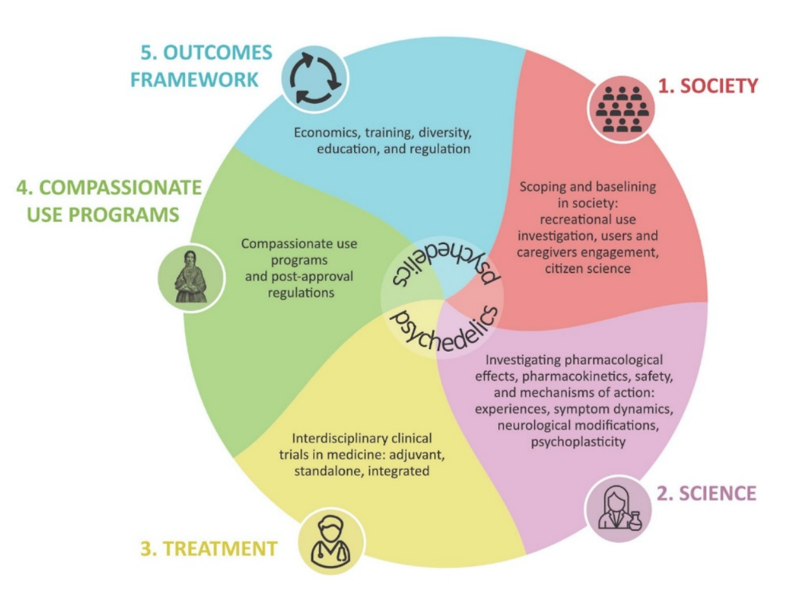
Integration Across Five Objectives
- Objective 1 – Societal Challenges: Activity 1.3 uses Sensiks for a “psychedelics pop-up interactive traveling exhibition,” immersively educating citizens and stakeholders.
- Objective 2 – Scientific Mechanisms: Multisensory environments serve as controlled settings to study how context modulates psychedelic-induced neuroplasticity and altered states.
- Objective 3 – Treatment Trials: Nine clinical workstreams (3.1–3.9) for depression, PTSD, OCD, addiction, pain and cluster headaches require optimized therapeutic environments.
- Objective 4 – Compassionate Use: Sensiks provides environmental infrastructure for certified healthcare centers delivering psychedelic therapy at scale.
- Objective 5 – Training & Outcomes: Experiential learning spaces for therapists and paramedics (Activities 5.2 and 5.4).
Deliverables Involving Sensiks
- Psychedelic NeuroCart test battery with standardized sensory environments.
- Interactive traveling exhibition for public education.
- Environmental design protocols for nine clinical trial streams.
- Therapist training facilities with sensory environment control.
- Specifications for healthcare centers in compassionate use programs.
Why Sensory Reality Matters
The PROMYSS proposal formulates key questions that make Sensiks’ role scientifically essential rather than optional.
- Safety & Set/Setting: “How safe are psychedelics in terms of interaction of intended pharmacological effects with set/setting?” — Sensiks provides standardized, reproducible environmental conditions for safety and interaction studies.
- Positive Contexts: “What is the role of a positive context?” — Multisensory immersion allows systematic creation and measurement of positive therapeutic environments.
- Translating Ceremonial Best Practices: The proposal aims to translate best practices from ceremonial and self-medication settings into medical scripts — Sensiks can replicate key parameters (darkness, music, natural sounds, scents, temperature).
- Patient & Therapist Perspectives: Activities such as 3.1 explore patient and therapist views on optimal care, with environmental design central to perceived safety, trust and depth of experience.
Positioned in a €1.1B European Mental Health Tech Ecosystem
PROMYSS runs in parallel with rapid growth of European digital mental health, neurotech and VR healthcare. Sensiks’ involvement connects psychedelic research to concrete reimbursement and deployment pathways.
PROMYSS: NWA-ORC Grant Proposal (Vermetten et al.)
Inline access to the uploaded PROMYSS grant proposal, detailing consortium structure, research questions, work packages, governance and implementation roadmap.
NWA-ORC 2022 Vermetten et al. — PROMYSS Grant Proposal
Embedded PDF viewer of the official grant application as provided to this page.
Sensiks: A Core Scientific Partner in Next-Generation Mental Health
PROMYSS confirms Sensiks’ Sensory Reality technology as scientifically essential infrastructure for psychedelic medicine, standing alongside 20+ Dutch professors, MAPS, Beckley Foundation, Compass Pathways and national health institutions. Environmental design is no longer decoration; it is a validated parameter of therapeutic efficacy.