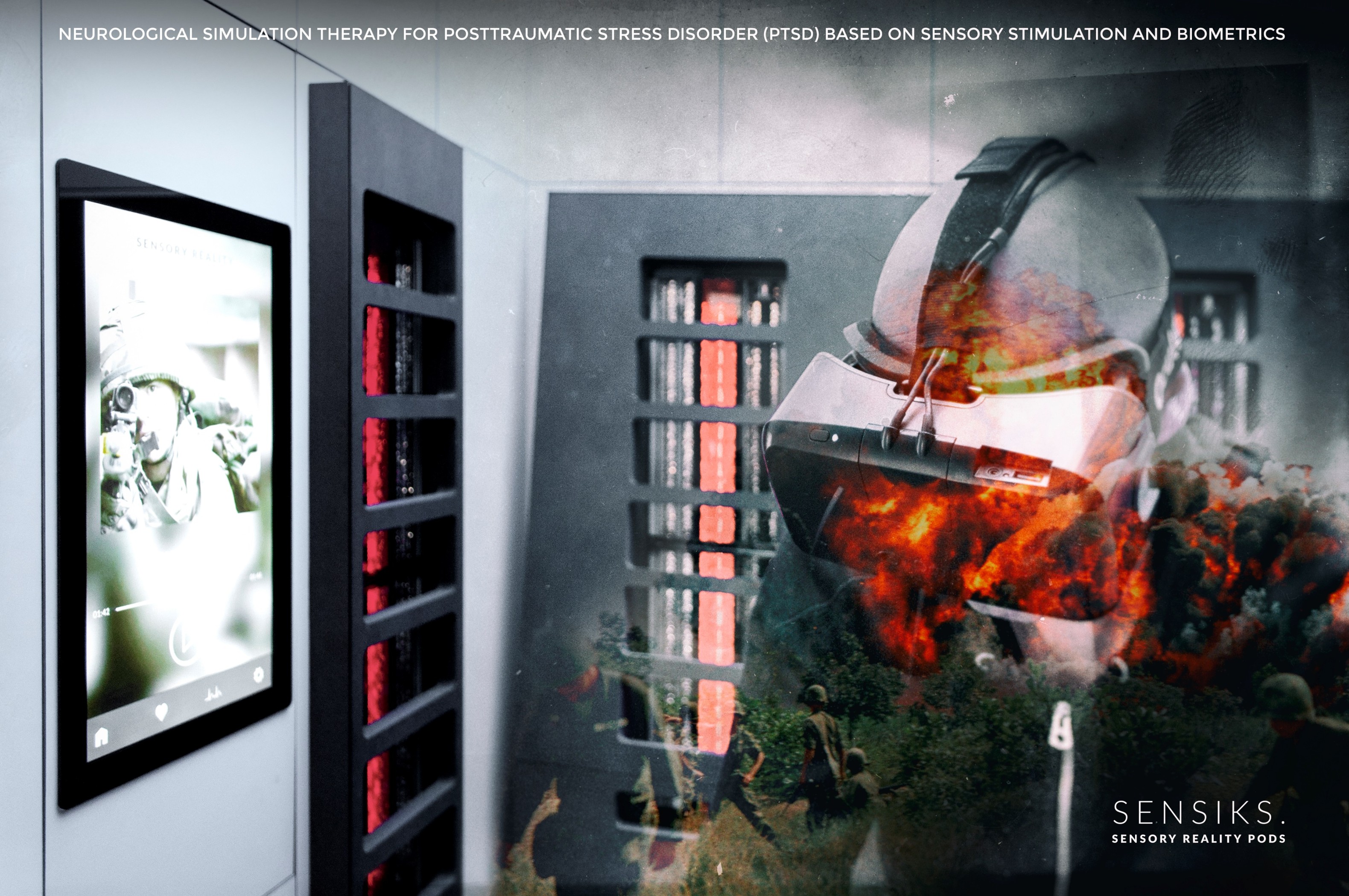
PTSD • Multisensory Immersive Virtual Reality Study

Multisensory Immersive Virtual Reality for PTSD Treatment

A doctoral research project at INRS-EMT and the MuSAE Lab demonstrates how nature-based multisensory VR, delivered through the SENSIKS platform, can reduce PTSD symptoms and improve cognitive function, while simultaneously tracking brain and physiological responses.

20 PTSD patients • 12 sessions • 3-week protocol Clinical trial: ISRCTN68760993
20
PTSD patients in specialised clinic
12
Multisensory VR sessions over 3 weeks
3 months
Post-treatment follow-up
Multisensory Immersive Virtual Reality for PTSD Treatment – SENSIKS INRS
OVERVIEW

Doctoral Research at INRS-EMT & MuSAE Lab

This project, led by doctoral researcher Belmir Jose de Jesus Junior under the supervision of Prof. Tiago H. Falk, explores the therapeutic potential of multisensory virtual reality nature immersion for treating Post-Traumatic Stress Disorder (PTSD).fileciteturn3file0

Why Multisensory VR for PTSD?

Traditional PTSD treatments can be effective but are often demanding and not accessible to everyone. This research investigates whether deeply immersive, nature-based virtual environments, enriched with realistic sensory cues, can help people with PTSD relax, process traumatic experiences and gradually restore a sense of safety.

Key idea: engaging multiple senses at once (sight, sound, smell, touch, temperature) may enhance immersion, emotional regulation and treatment response, while remaining safe and acceptable for patients.

Study Context

The work was conducted at the MuSAE Lab (Multimedia Signal Analysis and Enhancement Lab), INRS-EMT, University of Quebec, with a clinical PTSD partner clinic in Sept-Îles, Quebec. Ethics approval was obtained from the INRS Research Ethics Committee (CER-22-669).

  • INRS-EMT, Université du Québec
  • MuSAE Laboratory (Multimedia Signal Analysis and Enhancement)
  • Specialised PTSD clinic in Sept-Îles, Quebec
PLATFORM & PROTOCOL

The SENSIKS Platform and Research Methodology

The study uses the SENSIKS multisensory pod as a research platform, integrating virtual reality, soundscapes, scent and haptic feedback to create controlled, repeatable nature experiences for PTSD patients.fileciteturn3file0

Multisensory Stimulation in the Pod

The SENSIKS system combines:

  • 360° immersive video presented via VR headsets
  • Surround sound audio environments
  • Olfactory stimulation (OVR ION2) with natural aromas such as forest, ocean breeze, grass and earth
  • Haptic feedback including vibroacoustic sensations, wind simulation and temperature control

Initial validation with 16 healthy participants showed that the audio-visual-olfactory combination significantly enhanced relaxation, immersion and quality of experience without inducing cybersickness.

Instrumented VR Headset

A custom biosensor-instrumented VR headset was developed to monitor brain and physiological activity during every session, including:

  • EEG (brain activity)
  • EOG (eye movements)
  • EMG (muscle activation)
  • PPG (heart and blood volume changes)

This integration enables real-time tracking of relaxation, arousal and engagement, and allows the discovery of predictive neuromarkers of treatment response.

CLINICAL INTERVENTION

Clinical Study and Participants

The main therapeutic study enrolled 20 patients diagnosed with PTSD at a specialised clinic in Sept-Îles, Quebec. Participants followed an intensive, structured protocol of multisensory VR nature immersion.fileciteturn3file0

Intervention Design

  • 12 immersive sessions over 3 weeks (4 sessions per week)
  • Each session lasted approximately 15 minutes
  • Synchronised visual, auditory, olfactory and haptic stimulation throughout
  • Nature scenes selected to promote calm and engagement
Nature environments: mountain lake (baseline), local beach with cardiac coherence breathing exercise and seaside forest with guided meditation.

Follow-Up and Assessment

Participants were re-assessed immediately after the 3-week intervention and again at 3 months. Both questionnaire-based and clinician-administered measures were used to evaluate symptom change and quality of life.

  • Clinician-Administered PTSD Scale (CAPS-5)
  • PTSD Checklist (PCL-5)
  • Patient Health Questionnaire (PHQ-9) for depression
  • Dissociative Experiences Scale (DES-II)
PSYCHOLOGICAL & COGNITIVE OUTCOMES

Treatment Outcomes and Breakthrough Findings

The study documented substantial improvements in PTSD symptoms, mood, dissociation and cognitive functioning, supported by objective neurophysiological changes.fileciteturn3file0

Psychological Improvements

  • PTSD severity: CAPS-5 scores decreased significantly and remained lower at 3-month follow-up.
  • Self-reported PTSD symptoms: PCL-5 scores declined after the intervention.
  • Depressive symptoms: PHQ-9 scores improved from pretest to posttest.
  • Dissociative tendencies: DES-II scores decreased and benefits were maintained at follow-up.

Cognitive Function Enhancement

  • Processing speed showed statistically significant improvement.
  • Sustained attention capacity increased after treatment.
  • Working memory and complex attention improved across the sample.

Together, these findings suggest that multisensory VR nature immersion can support both emotional recovery and cognitive restoration for PTSD patients.

BRAIN & PHYSIOLOGY

Neurophysiological Validation and Predictive Biomarkers

Beyond questionnaires, the instrumented VR headset allowed detailed analysis of brain and physiological responses during treatment, helping to explain why and for whom the intervention works.fileciteturn3file0

Key EEG and Physiological Findings

  • Increased alpha and theta power in frontal and parietal regions, associated with relaxation and internal focus.
  • Positive shift in parietal alpha asymmetry, suggesting reduced hyperarousal and depression-related activity.
  • Decreased beta and gamma activity in patients who benefited the most from treatment.

These patterns provide converging evidence that multisensory VR exposure can help the brain move from a highly aroused, threat-focused state toward calmer, more regulated functioning.

Innovation in Treatment Monitoring

A major contribution of this work is the development of a comfortable, non-invasive, biosensor-integrated VR headset that can:

  • Monitor neurophysiological responses in real time during treatment.
  • Allow personalised adjustments to intervention parameters.
  • Identify predictive biomarkers of treatment success as early as sessions 4–5.

Such markers could help clinicians tailor interventions, potentially saving time and focusing resources on strategies most likely to help each individual patient.

COLLABORATION & SIGNIFICANCE

Participating Institutions and Future Applications

The project brings together academic, clinical and international partners, and points toward new, evidence-based digital therapeutics for PTSD.

Key Institutions and Collaborators

  • Primary Institution: INRS-EMT, Université du Québec (Montreal, Canada)
  • MuSAE Laboratory: Multimedia Signal Analysis and Enhancement Lab
  • Clinical partner: Specialised PTSD Clinic, Sept-Îles, Quebec
  • International collaboration: Federal University of Health Sciences of Porto Alegre, Brazil

The work was overseen by an evaluation committee including Prof. Shervin Vakili, Prof. Giacinto Barresi and Prof. Sarah Power.

Significance and Future Directions

  • Demonstrates that multisensory VR nature immersion is a safe, acceptable PTSD treatment option.
  • Offers a scalable format that could be delivered in clinics and, in future, potentially at home.
  • Combines subjective reports with objective neurophysiological data for stronger evidence.
  • Supports personalised mental health care using predictive neuromarkers.

Clinical trial registration: ISRCTN68760993.

FULL STUDY

Read the Full Research Paper

For in-depth methodology, statistics and detailed neurophysiological analyses, consult the full peer-reviewed article.

If the PDF does not load, you can open it in a new tab.

FAQ

Frequently Asked Questions

These short answers summarise the main takeaways of the study. For clinical decisions or treatment planning, always consult qualified health professionals.fileciteturn3file0

Is multisensory VR a replacement for standard PTSD therapies?

The study presents multisensory VR as a promising, evidence-based intervention and potential complement to existing therapies. It does not claim to replace established treatments, but rather to expand the toolkit available to clinicians.

Are there side effects or risks?

The protocol was generally well tolerated, with high patient acceptance and minimal adverse effects reported. Standard VR screening and monitoring procedures were followed to minimise cybersickness or discomfort.

Can this kind of treatment be used at home?

The research suggests that the approach is potentially scalable and could in the future be adapted for home use, especially as VR hardware becomes more accessible. Further studies are needed to validate home-based protocols.

Interested in Multisensory VR for PTSD Research?

This page is an educational overview of an independent PTSD study using the SENSIKS multisensory platform. For collaboration, implementation or further information about using nature-based VR in trauma and mental health research, please get in touch.

Contact SENSIKS